
The Industrialized AI Delivery Blueprint.
Enterprise AI has a delivery problem. Companies build models and deliver AI solutions like cowboys in the wild west — it's how billion-dollar AI investment failures happen. It's time to industrialize AI delivery from idea to production.
The Business Value of Industrialized AI
Enterprise AI investment is surging toward $2.5 trillion. But a staggering majority of that investment never reaches production — and the gap between spending and value is widening.
The numbers should alarm every CEO, CIO, and board member. 88% of AI proofs of concept never reach production. Roughly 74% of companies fail to achieve scalable business value from their AI investments. Enterprises are spending more than ever, producing more AI use cases than ever, and getting less return than ever.
This is not a technology problem. The use cases are promising. The algorithms are sound. The cloud infrastructure is mature. What's broken is everything that happens after a solution owner launches an agent, a business unit introduces Vendor AI, or a data scientist builds a model — the process of getting it into production, governing it, measuring it, and scaling it across the enterprise.
Last year, the question enterprises asked was: "How fast can we deploy AI?" This year, the question has changed. Now they're asking: "Which AI investments are actually delivering value? And how do we scale the ones that work?"
0%
Of AI POCs never reach production
0%
Of companies fail to achieve scalable AI value
0+
Months · average time to production
The Cottage Industry.
Most enterprises build and deliver AI the way craftsmen built furniture in the 18th century: one piece at a time, by hand, with no shared standards, no central inventory, and no way to scale.
Walk into most Fortune 500 companies today and you'll find the same pattern. Dozens of teams building or acquiring AI independently. Each with different tools, different processes, different governance standards. Use cases, models, vendor AI, agents all tracked in spreadsheets — if they're tracked at all.
We call this the Cottage Industry problem.
Shadow AI proliferates.
A stunning 98% of CEOs report that they do not know where AI is being used across their organizations.
The Governance Tax compounds.
We estimate that 50% of AI projects are delayed or abandoned due to process friction — not because the technology failed, but because the organization couldn't get out of its own way.
Fragmented portfolios resist measurement.
When dozens of teams build and source AI independently, organizations end up with fragmented portfolios that make ROI demonstration nearly impossible.
The Explosion That Broke the System.
The Cottage Industry was manageable when enterprises had 10 or 20 traditional models. Then generative AI arrived and Agentic AI broke the system. The number of proposed use cases exploded by an order of magnitude.
67% of enterprises now report 101 to 250 proposed AI use cases. Yet 94% of enterprises report fewer than 25 systems actually in production. The gap between ambition and execution has never been wider.
"The bottleneck isn't innovation. It's delivery infrastructure."
The culprit is not a lack of talent or technology. It's the absence of delivery infrastructure — the operational layer that connects a use case for ML, GenAI, and agents to business usage with the right level of enterprise rigor and standards.

.avif)
.webp)
Industrialization Imperative.
The history of every major technology is the same: invention comes first, then industrialization. AI has completed the first phase. It's time for the second.
Consider what happened when manufacturing evolved from craftsmen to assembly lines. It systematized processes and standards. Enterprise AI needs the same transformation — the industrialization of everything that happens around AI use cases, how they're implemented, and how they're delivered from idea all through production and beyond.
"The next phase of enterprise AI is defined by who can deliver AI at industrialized scale — rapidly, reliably, responsibly, and profitably."
The AI Delivery Engine.
Industrialized AI delivery requires more than visibility. It requires an engine — a system that doesn't just show you a list of tasks or policies, but mechanically moves the work from idea to production.
This is the distinction we draw at ModelOp between an inventory or registry and a dynamic AI System of Record. Visibility alone is a parked truck. You need the engine to move the weight.
The system of record needs power. The ModelOp AI Delivery Engine (MADE™) — our proprietary, agentic-powered engine — provides that power with supercharged capacity. It's built on three core capabilities:
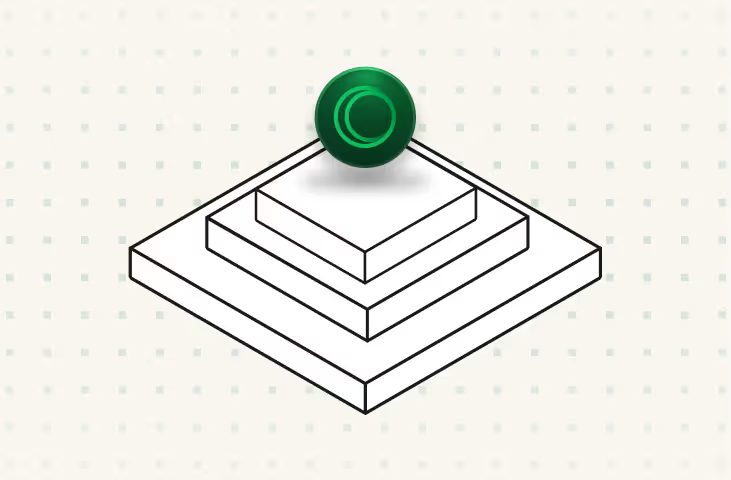
Full integration with your existing technology & AI stack.
Syncs model registries — MLflow, Bedrock, SageMaker, Azure ML, Vertex AI. Integrates with data, security, ITSM, GRC, CI/CD, and enterprise systems. No rip-and-replace. Deploys on any cloud, on-prem, or hybrid. Completely vendor agnostic.
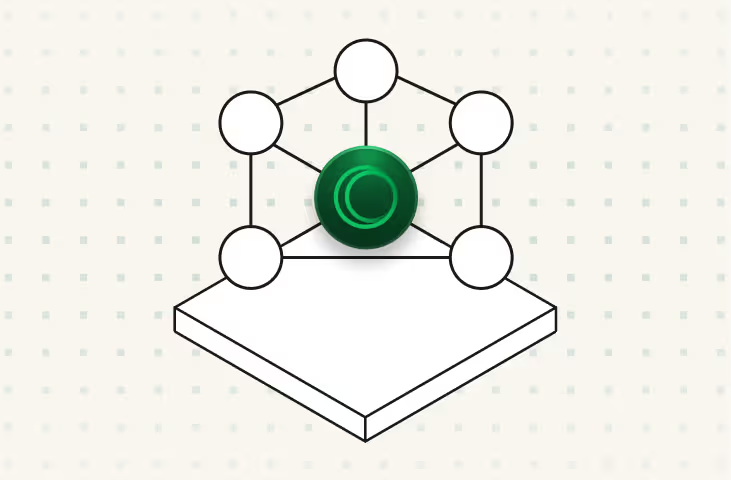
Workflow engine for every stakeholder team.
IT, business, AI owners, data, security, architecture, ops/prod support, governance, risk, and compliance all work in the same workflow — with policy enforced at every step of the AI lifecycle, not in committee. The right people get the right information at the right time to drive AI delivery from idea to production and beyond.

Pluggable AI agents handle the work.
Our proprietary framework for plugging agents — from customers, partners, or ModelOp — into ModelOp workflows. Further accelerates the AI lifecycle and scales AI delivery 10X without adding headcount.
Enterprises that deploy MADE™ see a 10X+ increase in time-to-value and an average of $20M in savings over status quo solutions.
The Enterprise AI Command Center.
MADE™ is the engine that powers ModelOp's Enterprise AI Command Center — the system of record that serves as the cockpit for managing the visibility, controls, and operational intelligence needed for Industrialized AI delivery.
The Enterprise AI Command Center provides four critical capabilities that industrialize AI delivery across ML, GenAI, Agentic, first-party, third-party, and traditional models.
Enterprise AI Command Center
AI Delivery Engine
Dynamic Interoperability
Integrations unify your existing AI stack — on-prem, cloud, or hybrid — into one vendor-agnostic operating layer above your MLOps, security, data, GRC, and ITSM systems.
Connective Automation
One workflow engine powers every stakeholder team — IT, business, AI, governance — driving AI from idea to production with policy enforced by design.
Agentic-Powered Framework
A framework for plugging customer, partner, and ModelOp agents into AI lifecycle workflows — guided by policy to scale delivery 10x without adding headcount.
The Enterprise AI Command Center sits above your existing AI stack — unifying MLOps, development, AI execution, GRC, security, data, and cloud infrastructure into a single operating layer. No rip-and-replace. No vendor lock-in. Your stack, your choice.
Agentic's Trust Challenge.
Agentic AI is transforming work, but enterprises are hesitant to trust agents — which slows and delays AI delivery. Agentic systems increase complexity and fundamentally change the nature of what must be monitored and governed.
These are autonomous systems that reason, plan, and take actions — interacting with external tools, making decisions in real time, and operating at a speed that makes human-in-the-loop review impractical for every transaction.
It is no longer sufficient to evaluate AI solely based on how it performs in a given test set. A flawed instruction could create a cascade of errors affecting hundreds of customers before anyone detects it. This is invisibility at scale.
Most enterprises are connecting agentic AI to 6 to 20 external tools, massively expanding third-party risk. Without governance infrastructure purpose-built for this reality, the enterprise is flying blind.
Minimum Viable Governance.
The answer to this complexity and trust problem is dynamic and enforceable governance applied in the right amount — enough to enable trust without creating paralysis.
To establish continual trust across all stakeholder groups — control partners, security, IT and technology — there must be ground rules. For GenAI and agentic systems, there are three minimum components:
Trustworthy Tracking
Comprehensive inventory and management of every component in an agentic solution — MCP tools, agent orchestrators, foundation models, guardrails, context databases, runtime policies — plus detailed tracking of usage, accountability, data, monitoring, and audit trail across all AI development and execution platforms.

End-to-End Enforcement
Ensure your agentic AI policy is enforced throughout the lifecycle — not checklists, but enforced accountability, gates, controls, risk assessments, reviews, and security scans.
Runtime Protection
Execution-level enforcement of security and governance policies — at a packet level — during production usage.
Together, these three pillars enable speed with trust by design. Not speed versus trust. Speed with trust.
The Choice Is Now.
Every enterprise faces the same decision: stay in the Cottage Industry, or industrialize. The window for choosing wisely is narrowing.
Every enterprise I talk to in the Cottage Industry is stuck between the same two bad options — Wild West innovation that overruns budgets, or rigid processes that strangle innovation.
There's a better choice — Industrialized AI delivery. ModelOp works with Global 2000 organizations that have moved from fragmented AI experimentation to governed, industrialized delivery.
0X
Faster time-to-value
0%
Policy adherence
0°
Portfolio visibility
$0M
Savings over status quo

"Enterprises must know when and how their AI is making decisions — and have mechanisms in place to intervene when necessary."
The future of enterprise AI is about who can deliver at industrial scale — rapidly, reliably, responsibly, and profitably. The Cottage Industry is over. It's time to industrialize AI delivery.
Dave Trier
Dave Trier is a builder at heart. With more than two decades of hands-on experience in data science, Al, analytics, cloud computing, and enterprise software, he has spent his career in the gap between what Al promises and what enterprises actually deliver.
Dave's path runs through Accenture Technology Labs, Think Big Analytics (a 400-person organization, acquired by Teradata), and Powered by Action as CTO. He holds multiple patents as a named inventor. After seven years as SVP of Product at ModelOp, he was appointed Chief Executive Officer in February 2026.
Sources & citations
- $2.5T projected AI spending — Gartner, 2026 forecast via Yahoo! Finance.
- 88% of AI POCs never reach production — ModelOp AI Governance Benchmark Report, 2026.
- 74% fail to achieve scalable business value — Boston Consulting Group.
- 98% of CEOs don't know where AI is used — Accenture CEO, World Economic Forum.
- 67% report 101–250 proposed use cases — ModelOp 2026 Benchmark Report.
- 94% fewer than 25 in production — ModelOp 2026 Benchmark Report.
- 87% of AI governance programs fail within 18 months — Rehan Kauser, CAIO, AI Advantages.
- 10X, 100%, $20M impact — ModelOp customer data, enterprise implementations.
Start the AI Delivery Engine
Request a demo to talk to our team and see how ModelOp can help you industrialize AI delivery.