The Control Tower for All Enterprise AI
See every AI solution, control every risk, prove every result. ModelOp automates end-to-end AI lifecycle management and governance for visibility into all internal and vendor AI, faster time-to-market with trust by design, and continuous control over costs and usage.



How ModelOp Streamlines Each Step in the AI lifecycle
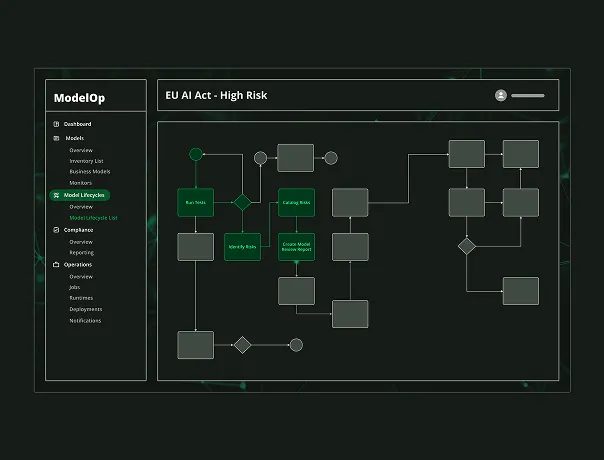
ModelOp provides self-service governance with role-based workflows that automate every step of the end-to-end AI lifecycle by integrating with and orchestrating your enterprise’s many processes and systems related to AI innovation and governance so you can bring AI to market faster.
Submit a New AI Use Case
- Standardize AI use case intake and registration
- Initiate the end-to-end AI lifecycle record
- Automatically ensure business, risk, and portfolio reviews are conducted
Assess Risk of Use Case Based on Policy
- Codify risk assessments for every AI use case
- Auto-generate the risk tier for each use case
- Auto-generate initial controls based on risk
Implement the AI Solution
- Track and manage the vendor or internal solution details
- Submit candidate AI solution through approval workflows to enforce reviews and policies
- Ensure the solution submission is verified and documented
Conduct Testing
- Continuosly run automated tests such as bias, drift, performance, and more
- Continuously track risks and collect evidence to stay audit-ready
- Automatically generate documentation and model cards
Review & Deploy
- Quickly request independent reviews
- Automaticially trigger notifications and alerts
- Consistenly enforce policies for approving production deployment
- Track and manage production deployments
Continuously Monitor & Review
- Monitor all use cases in production from a single system of record
- Easily conduct regular reviews
- Quickly perform annual attestations
- Automatically update policies and processes
See How ModelOp Brings AI to Market Faster and at Scale
This 6-minute introductory demo shows how ModelOp’s AI lifecycle management and governance platform establishes visibility into all AI, gets AI into production faster with enforceable policies, controls costs, and integrates with existing enterprise systems to orchestrate governance.
Operationalize AI Lifecycle Management and Governance
ModelOp provides the technical and operational backbone to implement responsible AI and balance its costs, risks, and value.
Without ModelOp
With ModelOp
Fragmented and invisible AI
Leaders don’t know what AI is being used, where it’s being used, who’s using it, and what the risks are.
Single AI system of record
Full visibility into the usage and risk of all AI across the enterprise from a single source of truth.
Siloed teams and manual processes
Manual operations across dozens of teams, systems, processes delay AI solutions by months or more.
Interoperability and orchestration
United collaboration, integrated systems, and continuous governance that accelerate AI time-to-market.
Inconsistent policy enforcement
Policies are inconsistently applied and enforced across different teams, business units, and geographies.
Automatic, consistent enforcement
100% assurance that all policies—internal and regulatory—are enforced across the entire enterprise.
No cost, value, or risk tracking
Limited ability to track the cost, benefits, and risks of AI use cases and align them to business objectives.
Continuous insights
Automated tracking and reporting on KPIs to identify bottlenecks, measure ROI, and inform business decisions.
FAQs about ModelOp and AI Lifecycle Management & Governance
What is AI Lifecycle Management?
AI lifecycle management is the discipline of continuously managing every AI system—machine learning, GenAI, Agentic, internal, vendor—from inception to retirement. It establishes a consistent set of processes to register, track, assess, monitor, and retire AI solutions across the enterprise, ensuring that every AI use case, solution, and model is accounted for, governed appropriately, and delivering measurable business value.
In practice, AI lifecycle management connects the many processes and teams—often dozens or more for each AI type—involved in bringing AI to market into one coordinated framework. This is essential because preparing AI solutions for production is not a linear path; they evolve, adapt, and carry risk throughout their lifetime. Without lifecycle management, enterprises face significant delays, inefficiencies, and potential compliance or reputation failures.
By standardizing oversight and embedding “trust by design,” AI lifecycle management allows organizations to scale safely and accelerate innovation. It ensures AI operates as a managed business asset—compliant, secure, and aligned with strategic goals—while protecting the enterprise from the growing risks of ungoverned AI.
Why is it important to manage AI as a portfolio of investments?
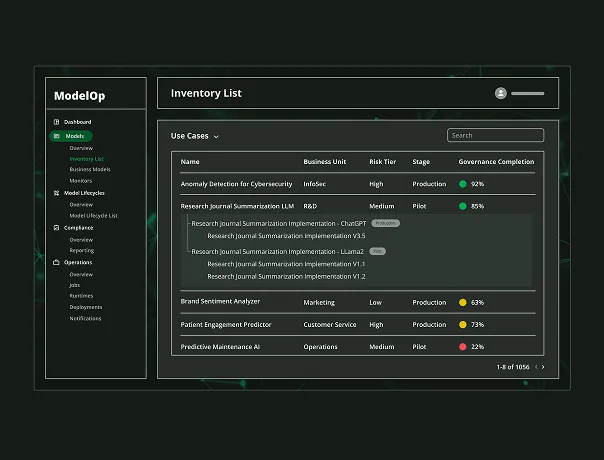
Enterprises have thousands of AI use cases proposed, in development, in pilot, or in production, and have a multitude of technologies and platforms—including those developed in-house, purchased from a third-party vendor, and embedded in SaaS. This collection of heterogeneous AI solutions is a dynamic portfolio of high-value, high-risk assets that demand the same financial and operational discipline as any other strategic investment. Treating and managing AI as a portfolio enables organizations to quantify ROI, eliminate redundancy, and ensure that resources are directed toward the use cases that deliver the greatest business impact.
This portfolio view is essential for balancing innovation, cost, and risk. It allows leaders to
compare performance across hundreds of AI systems, identify which projects to scale or retire, and demonstrate measurable value to boards and decision makers. In the age of Agentic AI—where costs and usage can quickly spiral—managing AI as a portfolio is the only way to maintain control, accountability, and trust-worthy innovation.
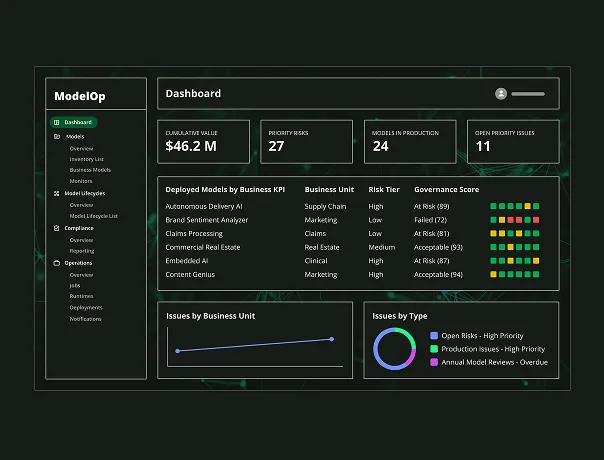
With ModelOp’s AI portfolio management capabilities, organizations can quickly and accurately answer these questions:
● How many AI systems are in production?
● Are there critical production issues?
● Which AI systems are related to top strategic priorities?
● Are there any high priority risks that need to be mitigated?
● How fast are we putting new AI systems into production?
● How much do AI use cases cost?
● Which AI platforms are most used for development and production?
● Which Business Units are leveraging AI the most?
● What is the ROI for my AI?
How is ModelOp different from AI Development and MLOps tools?
AI development and MLOps tools (e.g., MLflow, SageMaker) focus on experimentation and
development, and enterprises can have upwards of thirty of these tools to meet the needs of data science teams. A unified AI governance platform needs to provide a single AI system of record at the enterprise level across all AI, including internally developed and third-party vendor systems. These tools don’t do that, ModelOp does.
Furthermore, AI development and MLOps tools are designed for data scientists to build and deploy internally developed models. ModelOp manages and governs what happens before, during, and after —from intake and approvals to monitoring, compliance, and retirement — for all models, including third-party vendor and embedded AI.
How is ModelOp different from Data Management and Data Governance platforms?
Data Management and Data Governance platforms (e.g., Databricks, Collibra) focus on data —including data catalogs, pipelines, and quality. AI use cases, solutions, and models are more than data and ModelOp is purpose-built for AI as the asset—managing its risk, business value, and compliance throughout its lifecycle. Data governance and AI governance are two entirely different functions—like comparing apples and oranges. Both are important, but they have very different needs and require unique capabilities.
How is ModelOp different from Governance, Risk, and Control (GRC) platforms?
GRC platforms (e.g., OneTrust, Archer, or Credo.ai) govern traditional business processes, not AI. ModelOp is purpose-built to govern the unique risks and dynamics of AI models— which requires continuous AI management, traceability & reproducibility, and monitoring against drift, bias, and more.
GRC platforms weren’t designed for AI-specific workflows or model management with
continuous governance. Many of our customers use their existing enterprise GRC systems for their policy definitions and integrate with ModelOp to enable automated change management to processes and governance workflows when policies are revised, which without ModelOp, would need to be done manually.
How is ModelOp different from IT Service Management (ITSM) systems?
ITSM systems (e.g. ServiceNow) lack native AI solution and model context. AI solutions are
high-value, risk-bearing assets and require purpose-built capabilities that differ from the needs of managing tickets. ModelOp focuses on AI as the asset—managing its risk, business value, and compliance throughout its lifecycle.
How is ModelOp different from AI Observability platforms?
AI Observability platforms focus on monitoring model performance—tracking metrics like
accuracy, drift, or bias once a model is deployed. ModelOp goes far beyond that. It provides
end-to-end AI lifecycle management and governance, automating every stage from registration and risk assessment to approval, monitoring, and retirement across all AI systems—ML, GenAI, Agentic, and third-party.
While observability tools answer “how is this model performing?”, ModelOp answers “should this model be in production at all—and under what conditions?” It connects performance data to governance processes, ensuring every AI system complies with enterprise policy, regulatory standards, and business goals. In short, observability is about watching models; ModelOp is about controlling and governing them at scale.
How is ModelOp different from IBM watsonx.governnace?
While IBM watsonx.governance provides governance tied to its enterprise ecosystem, ModelOp distinguishes itself through deeper lifecycle automation and cross-stack interoperability — managing traditional, generative, and agentic AI across any environment via 50+ integrations, giving enterprises a neutral control tower that orchestrates governance across all platforms, not just IBM’s.
IBM's Focus:
IBM watsonx.governance is a governance solution designed primarily for AI models developed and deployed within the IBM watsonx ecosystem. It centralizes documentation, captures metadata, and provides dashboards for transparency, explainability, and bias management—mainly within IBM’s platform environment.
ModelOp’s Role:
ModelOp delivers enterprise-wide AI lifecycle management and governance across all AI—traditional ML, GenAI, Agentic, and third-party systems—regardless of where they’re built or run. ModelOp acts as an independent AI Control Tower that unifies governance across diverse platforms, vendors, and clouds.
What ModelOp Adds:
- Centralized inventory covering every AI use case and system enterprise-wide—regardless of development and deployment environments
- Continuous, automated risk scoring and control enforcement across heterogeneous environments
- Lifecycle automation for documentation, validation, and compliance reporting
- Integration with 50+ AI and IT systems to orchestrate cross-functional governance workflows
- Real-time performance monitoring for drift, bias, and policy violations
- Executive dashboards tracking AI value, cost, and risk over time
How They Work Together:
Organizations that use IBM’s AI development tools often integrate them with ModelOp to achieve unified oversight across multi-vendor AI environments. IBM watsonx.governance manages compliance within IBM’s ecosystem; ModelOp offers governance across the entire enterprise, ensuring consistent controls, reporting, and automation for every AI system—no matter the platform.
How is ModelOp different from ServiceNow?
ModelOp and ServiceNow are very different, but do serve complementary roles in the AI ecosystem. ModelOp integrates with ServiceNow to help standardize AI use case intake or route change management tickets.
ServiceNow’s Focus:
ServiceNow is an IT service management platform—built to automate predictable business workflows like IT support, HR, or operations requests. These processes are deterministic, structured, and low-risk.
ModelOp’s Role:
ModelOp is purpose-built for AI Lifecycle Management and Governance, handling the dynamic, high-risk, and continuously changing nature of AI systems.
What ModelOp Adds:
- Manages all technical and governance assets for 1st- and 3rd-party AI systems
- Continuously assesses and mitigates AI risk across the lifecycle
- Automates documentation, reporting, and policy enforcement
- Monitors drift, bias, and performance for every AI system
- Generates alerts, dashboards, and audit-ready insights
How They Work Together:
Enterprises integrate ModelOp with ServiceNow so ModelOp can detect AI risks or policy violations and automatically open ServiceNow tickets for human review. Example: if a model drifts beyond its threshold, ModelOp can block deployment, trigger a ServiceNow change request, and route it for resolution.
How is ModelOp different from Databricks?
Databricks and ModelOp serve very different purposes and operate at different levels of the enterprise data and AI stack.
Databricks's Focus:
Databricks is a data and AI engineering platform designed for collecting, preparing, and training models at scale. It’s primarily used by data scientists and engineers.
ModelOp’s Role:
ModelOp operates one layer above—as the AI Control Tower that governs, automates, and monitors all AI systems across business units, regardless of where they were built or deployed.
What ModelOp Adds:
- Centralized inventory of all AI use cases and systems
- Automated risk scoring, compliance checks, and lifecycle workflows
- Continuous performance monitoring across ML, GenAI, and Agentic AI
- Executive dashboards for cost, value, and ROI of AI investments
How They Work Together:
Databricks accelerates model creation; ModelOp ensures those models are compliant, traceable, and performing as intended. Together, they enable enterprises to innovate responsibly and at scale.
How is ModelOp different from Collibra?
Collibra provides data governance, whereas ModelOp provides AI governance—two completely different functions that require different toolsets.
Collibra’s Focus:
Collibra provides data governance—ensuring data assets are cataloged, well-defined, and trusted.
ModelOp’s Role:
ModelOp delivers AI governance—managing the lifecycle, risk, and performance of AI systems that use that data.
What ModelOp Adds:
- Inventories AI use cases, models, and third-party systems
- Automates governance workflows and compliance checks
- Tracks bias, drift, and performance across the AI portfolio
- Provides role-based dashboards for technical and business leaders
How They Work Together:
Collibra answers “What data do we have and who owns it?” ModelOp answers “What AI is using that data, is it behaving as expected, and can we trust it in production?”
How is ModelOp different from Credo.ai?
Credo.ai is a GRC system specifically designed for AI systems, whereas ModelOp is an AI governance platform that automates and orchestrates the end-to-end AI lifecycle. Both ModelOp and Credo address governance, but with very different scopes and depths.
Credo’s Focus:
Credo.ai is a GRC-style AI governance tool, focused on defining responsible AI policies and frameworks like the EU AI Act or NIST AI RMF.
ModelOp’s Role:
ModelOp is an AI Lifecycle Management and Governance platform—built to execute, automate, and enforce those policies in production environments across business, technical, and compliance teams.
What ModelOp Adds:
- Centralized AI use case inventory with continuous risk and value tracking
- Automated policy enforcement across existing enterprise systems
- End-to-end lifecycle orchestration—from intake to retirement
- Real-time monitoring and reporting for AI risk, cost, and ROI
How They Work Together:
Credo helps organizations define policies and standards; ModelOp helps them execute and enforce those policies and standards at scale—often integrating directly with GRC tools like OneTrust or Archer.